+63 966 079 0909
  aabiotek@gmail.com
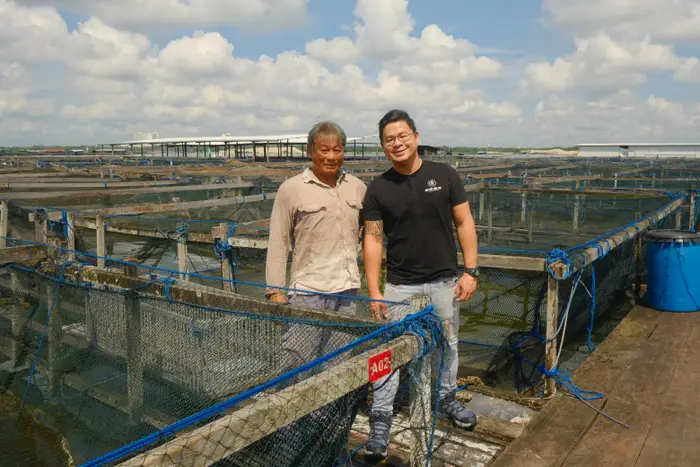
In the tranquil waters of the Johor Straits, where Singapore meets Malaysia, Alvin Yeo navigates his skiff towards his family’s floating fish farm. The five-minute ride from Lim Chu Kang jetty offers a glimpse into a world that once flourished but is now in decline. Singapore’s floating fish farms, known locally as kelongs, are remnants of a bygone era—symbols of resilience battling against the tide of modern challenges.
A Legacy on the Water
Formed by interlocking wooden planks secured by thick nails and floating barrels, these platforms represent Singapore’s fishing heritage. Yeo’s father, a former civil engineer, ventured into aquaculture in the 1990s out of sheer passion. “My father loves rearing fish,” says Yeo, 35, reflecting on how their Heng Heng Fish Farm has struggled to remain viable amid rising costs and cheaper imported seafood.
Once ubiquitous, the number of sea-based fish farms in Singapore has declined from 98 in 2023 to just 74 by October 2024, according to the Singapore Food Agency (SFA). The shrinking numbers are symptomatic of broader issues plaguing traditional farming in a high-cost urban environment.
Rising Costs and Imports Undercut Local Farmers
Operational expenses, from electricity to labor, make farming in Singapore a daunting venture. “You can’t compete with imports from China, Indonesia, or Malaysia,” says Yeo. His farm grows tilapia, a hardy fish that can be harvested within six months. Despite producing 12 batches of around 7,000 fish annually, profits are slim.
Maintaining wooden structures adds to the financial strain. “A metric ton of Chengal wood costs up to SG$4,000,” Yeo explains. Additionally, Singapore’s proximity to tropical waters exposes these farms to environmental threats, such as rising sea temperatures and algae blooms, which deplete oxygen levels and cause widespread fish mortality (Toh, 2023).
Embracing Modern Solutions
To combat these challenges, Yeo has introduced sustainable practices, including pelleted fish feed and solar panels to reduce dependency on diesel generators. While these innovations lower environmental impact, they also entail high upfront costs, making adoption challenging for many farmers.
Dean Jerry, an aquaculture professor at James Cook University, emphasizes the need for closed-cage containment systems. These technologies offer greater environmental control but are costly due to the lack of mains power in sea-based farms (Jerry, 2024). “Technological solutions are essential, but power requirements add an extra layer of complexity,” he notes.
Government Initiatives and Industry Support
Recognizing the precarious state of aquaculture, the Singapore government launched the Singapore Aquaculture Plan in November 2024. This initiative aims to boost local fish production through genetically superior stock and by facilitating exports to markets like China. Farmers can also access funding for technology adoption or opt for job-matching programs if they choose to exit the industry (SFA, 2024).
In 2023-2024, some farmers took advantage of a SG$100,000 grant to wind down operations. Yet, young entrepreneurs like Wong Jing Kai are finding innovative ways to sustain their businesses. Wong, who runs Ah Hua Kelong, supplements his farm by supplying fish to his restaurant, Scaled, and a hawker stall specializing in fish soup.
The Future of Singapore’s Aquaculture
For Yeo, the dream extends beyond floating farms. “I hope to establish a high-tech, land-based farm where conditions are more predictable,” he shares. Until then, he continues navigating the tides of uncertainty, driven by a deep connection to the sea.
As Singapore edges closer to its “30 by 30” goal—producing 30% of its nutritional needs locally by 2030—floating fish farms remain a crucial part of the equation. But their survival depends on a delicate balance of innovation, government support, and consumer willingness to embrace local produce.
Singapore’s floating fish farms are more than relics; they are living testaments to resilience and sustainability. Explore how AA Biotek’s innovative probiotics can support aquaculture by enhancing fish health and reducing environmental impact. Let’s preserve this vital tradition while paving the way for a sustainable future. Visit our website to learn more.
References
- Jerry, D. (2024). Sustainable aquaculture technologies: Challenges and opportunities. Aquaculture Research Journal.
- Singapore Food Agency. (2024). Singapore Aquaculture Plan: Enhancing food security.
- Toh, T. (2023). Impact of algae blooms on tropical aquaculture. Journal of Marine Biology.